Key facts: Structural Drying
- Professional water restoration drying is guided by the ANSI/IICRC S500 standard [1].
- Every day a wall or floor stays wet raises the chance of mold, which is why drying targets the first 48 hours [2].
- Dehumidifiers remove water vapor from air by cooling it below its dew point or by using a desiccant [3].
- Relative humidity is the amount of water vapor in air compared with the most it could hold at that temperature [4].
How it works
Evaporation, air movement and dehumidification
Drying a building is a balance of three things. Water in a material evaporates into the air touching it. Moving air carries that moist layer away so more can evaporate. A dehumidifier then removes the water vapor from the room so the air can keep absorbing it. If any one of the three is missing, drying stalls.
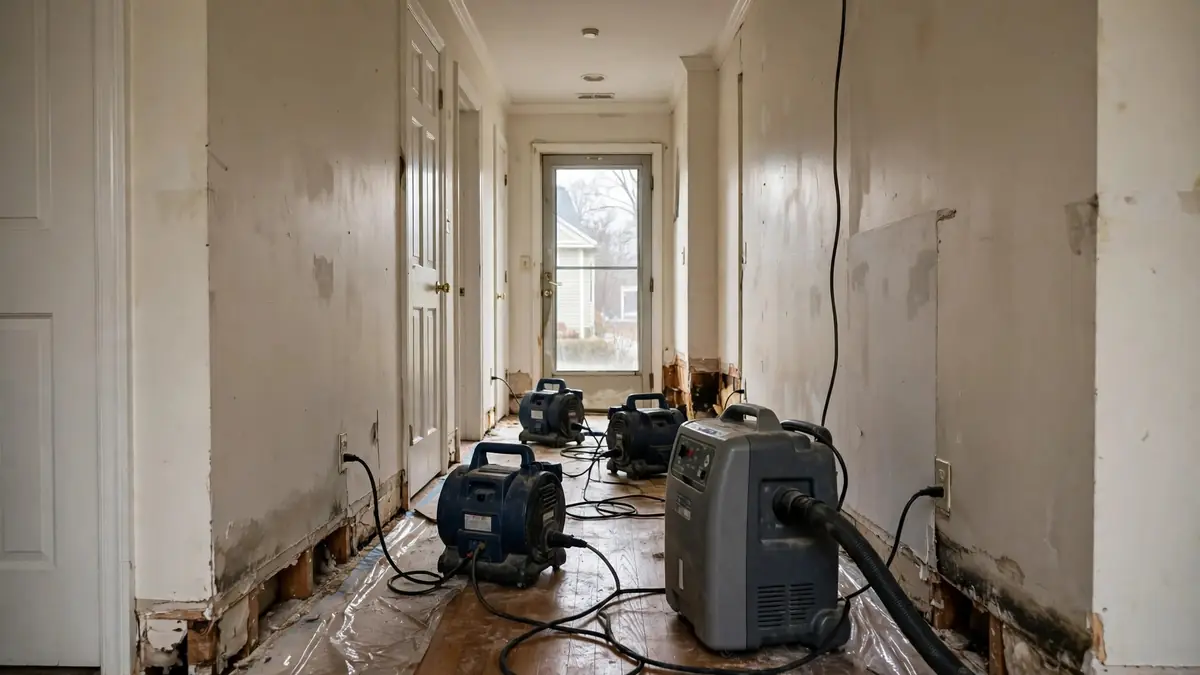
Air movers are the low, snail-shaped fans you see lined up along walls. They blow fast air across wet surfaces, breaking up the damp boundary layer. Dehumidifiers come in two main kinds. Refrigerant units, including the low-grain refrigerant (LGR) units most restorers use, cool air below its dew point so water condenses on a coil. Desiccant units pass air over a moisture-absorbing material and work better in cold spaces [3].
Temperature matters too. Warm air holds more water vapor, and warm materials give up moisture faster. That is why restorers watch relative humidity, the share of the air's moisture capacity already used [4], and the temperature of the room together. A cold Connecticut basement in February dries very differently from a sunlit living room in July.
Professional drying in the United States follows the ANSI/IICRC S500 standard, which sets out how to assess a wet structure, choose equipment and confirm when it is dry [1]. The contractor you speak with should be able to explain how they apply it in your house.
Signs
Signs a structure is still wet after the visible water is gone
These are the clues that moisture is hiding in the building.
Musty smell days later
A damp, earthy odor usually means a material is still wet and microbes have started to grow.
Paint bubbling or peeling
Moisture pushing out of drywall or plaster lifts paint and can leave brown tide lines.
Baseboards pulling away
Wood trim swells and separates from the wall when water is still in the bottom of the drywall.
Floors cupping or soft
Cupped hardwood or a spongy feel underfoot means the subfloor still holds water.
Condensation on windows
Fogged glass in a closed-up house shows the indoor air is saturated and nothing is removing it.
White powder on concrete
Efflorescence, a salty white crust, forms as water moves through masonry and evaporates [5].
Measuring
How restorers measure what is still wet
Drying is managed by numbers. On the first visit, a technician takes readings in affected and unaffected areas of the same material. The unaffected reading becomes the dry goal for that material. Drywall, pine framing, oak flooring and concrete all have different normal readings, so each needs its own reference point.
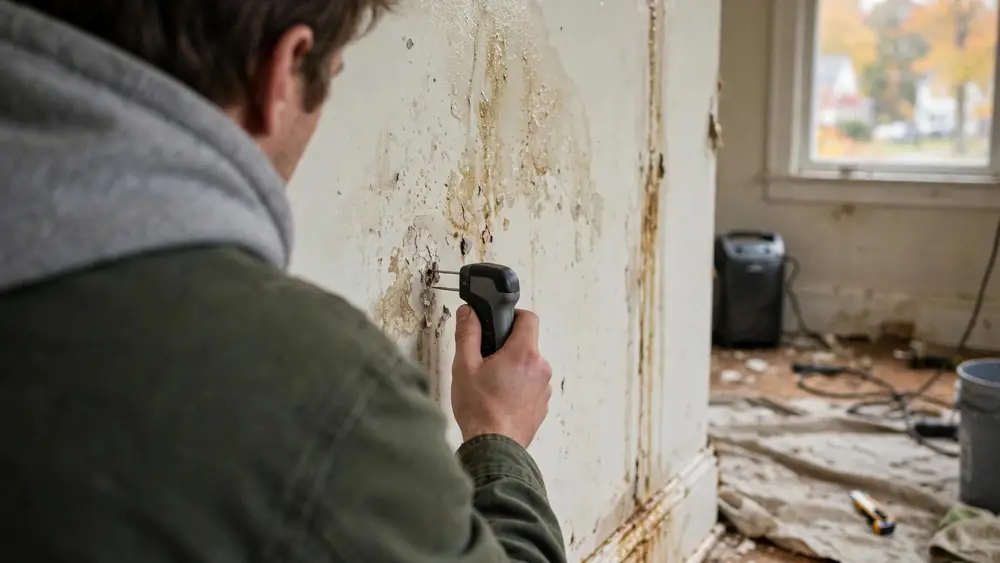
Pin meters push two small probes into a material and measure electrical resistance. Pinless meters sense moisture through the surface without damage. Thermo-hygrometers measure air temperature and humidity, and from them the technician works out how much water the air is actually holding. Thermal cameras help find suspect areas, which are then confirmed by meter.
Readings are logged at the same spots every day. The trend tells the story: if numbers are dropping steadily, the setup is working; if they stall, equipment needs to be moved or added, or a material needs to be opened up. A written drying log is also strong evidence for an insurance claim.
The job
How a structural drying job usually runs
Most homes need three to five days of drying, though some take longer.
- 1
Moisture map
Readings across floors, walls and ceilings outline the wet area, usually larger than it looks.
- 2
Remove what will not dry
Saturated pad, swollen particleboard and insulation are removed. Baseboards may come off so air can reach the wall bottom.
- 3
Open cavities where needed
Small holes behind baseboards or a cut along the bottom of drywall let air into wall cavities without replacing the whole wall.
- 4
Set equipment
Air movers are angled along walls and dehumidifiers sized to the room volume and water load. Rooms may be closed off with plastic to form a smaller drying chamber.
- 5
Check daily
The technician returns to read the same points, empty or check dehumidifiers, and move air movers as areas dry.
- 6
Adjust
Stalled areas get more airflow, heat or targeted drying, such as wall cavity injection systems.
- 7
Confirm dry
When each material matches its dry goal, readings are recorded and equipment comes out.
- 8
Hand off to repair
Only then should drywall, insulation, flooring and paint be replaced.
Materials
How common Connecticut building materials dry
General patterns; readings decide in each house.
| Material | Behavior when wet | Usual approach | Typical concern |
|---|---|---|---|
| Drywall | Absorbs quickly, wicks upward | Dry in place if clean water and firm; cut out if sagging or contaminated | Mold on the paper facing |
| Plaster on lath | Dense, slow to wet, slow to dry | Usually dried in place; holes for cavity air | Loose keys, lead paint in older homes [6] |
| Wood framing | Absorbs slowly, dries well | Dried in place with airflow and dehumidification | Hidden moisture in sill plates |
| Plywood or OSB subfloor | OSB swells at edges | Dried from above and below where possible | Delamination, soft spots |
| Solid hardwood | Cups as it absorbs from below | Drying mats plus dehumidification | Permanent cupping or crowning |
| Concrete slab and block | Holds water for a long time | Long dehumidification, sometimes heat | Efflorescence, damp smell |
| Fiberglass insulation | Holds water, compresses | Usually removed and replaced | Mold and lost insulating value |
Drying chambers
Why restorers close rooms off
Dehumidifiers work best in a defined volume of air. If the whole house is open, a dehumidifier in the wet room is effectively trying to dry the entire building, including the humid outdoor air leaking in. Restorers often tape plastic sheeting across doorways or hallways to make a drying chamber: a smaller space with the wet materials, the air movers and the dehumidifier.
Closing exterior windows is usually part of the plan, especially in summer when the outside air is humid. In some conditions, such as cool, dry autumn days, the contractor may use outdoor air to help. Every decision comes back to the readings: whether the air inside is drier than the air coming in.
In older Connecticut houses with balloon framing, where wall cavities can run from basement to attic, water and moist air can travel further than expected. The contractor may check rooms above and below the obvious wet area for that reason.
Wall cavities
Drying inside walls without tearing them out
Water that runs down inside a wall soaks the bottom plate, the lower drywall and any insulation. Air blowing across the outside of the wall does little for the inside. The common fix is to remove the baseboard and drill small holes or cut a narrow strip near the floor so air can enter the cavity.
Some contractors use injection systems: hoses fed into the holes push dry air up through the cavity. When insulation is soaked, it is usually removed through a cut along the bottom of the wall. The goal is to save as much wall as possible while making sure nothing stays wet out of sight, which is how hidden mold starts [2].
Why it fails
Why drying sometimes takes too long or misses areas
Drying runs long for predictable reasons. Equipment is turned off at night because of noise. Windows are left open on humid days. Too few dehumidifiers are used for the amount of water in the materials. Or a material that will not dry, such as vinyl flooring over wet subfloor, is left in place and traps the moisture below it.
Drying also fails when it stops too soon. A wall can feel dry and look fine while the bottom plate is still wet. Closing a wall over wet framing invites mold and odor weeks later. That is why the standard practice is to compare every material to its own dry reading and record it before rebuilding.
Finally, over-drying is a risk with some materials. Hardwood and fine furniture can crack if dried too hard and too fast. A careful contractor balances speed with the material's tolerance.
DIY vs pro
What homeowners can help with during drying
These small things make a real difference.
- Keep equipment runningAir movers and dehumidifiers work around the clock. Unplugging them adds time.
- Keep doors and windows as instructedThe contractor may want a room closed or open depending on the outdoor air.
- Keep the heat steadyIn winter, a warm, steady temperature helps drying. Do not let the house go cold.
- Empty dehumidifiers if askedSome units drain through a hose; others need the bucket emptied.
- Watch for changesNew stains, smells or drips should be reported to the contractor on their next visit.
- Keep kids and pets away from cordsThe equipment uses many cords and moves air hard enough to lift papers.
Connecticut specifics
Drying in Connecticut's climate and housing
Connecticut's weather swings make drying a seasonal job. In summer, humid air off Long Island Sound means outdoor air is rarely useful for drying, so homes are closed up and dehumidifiers do the work. In winter, heated indoor air is relatively dry, which helps, but cold basements and crawl spaces slow evaporation and may need desiccant dehumidifiers or added heat.
Older homes are common across the state. Plaster walls in New Haven and Waterbury houses dry more slowly than drywall and are often worth keeping. Paint in homes built before 1978 may contain lead, so cutting or sanding painted surfaces needs care [7]. Very old pipe insulation, flooring and other materials can contain asbestos and should be tested before disturbing them [8].
Many Connecticut basements have stone or block foundations that never fully dry. A restorer focuses on bringing the house's wood and drywall back to normal while managing basement humidity over the long term, often with a permanent dehumidifier.
The visit
Daily check-ins during drying
After setup, a technician usually returns once a day. Each visit has the same routine: read the meters at the logged points, check the air temperature and humidity in each chamber and outdoors, look at the dehumidifier output and move equipment as areas dry.
You should be able to see the readings, either on paper or in an app. If a number has not moved in two days, ask why and what will change. The contractor should explain whether more equipment, more demolition or a different approach is needed.
When drying finishes, the final readings are recorded and the equipment is collected. Repairs, such as replacing drywall and flooring, usually follow, either by the same contractor or another one you choose.
Safety
Living with drying equipment
Drying equipment draws a lot of power. Several dehumidifiers and a dozen air movers can overload household circuits, so the contractor should plan the electrical load and avoid daisy-chained extension cords. Ask before plugging in anything else on the same circuits.
The noise is constant and the air is warm and fast-moving. Some people stay with family while equipment runs, especially if a bedroom is part of the drying chamber. Air movers can also kick up dust, so if the water was contaminated, the contractor should clean surfaces before turning them on, and may use HEPA air scrubbers to filter the air.
Equipment
The machines in a drying setup
A typical setup combines several of these.
| Equipment | What it does | Where it is used |
|---|---|---|
| Centrifugal air mover | Blows a fast, low sheet of air across floors and walls | Along walls, under cabinets, across carpet |
| Axial air mover | Moves a large volume of air through a room | Open rooms, basements, crawl spaces |
| LGR dehumidifier | Condenses water vapor out of warm room air | Most living spaces above grade |
| Desiccant dehumidifier | Absorbs moisture even in cold air | Cold basements, crawl spaces, dense materials |
| Wall cavity injector | Pushes dry air into closed walls through small holes | Wet walls worth keeping |
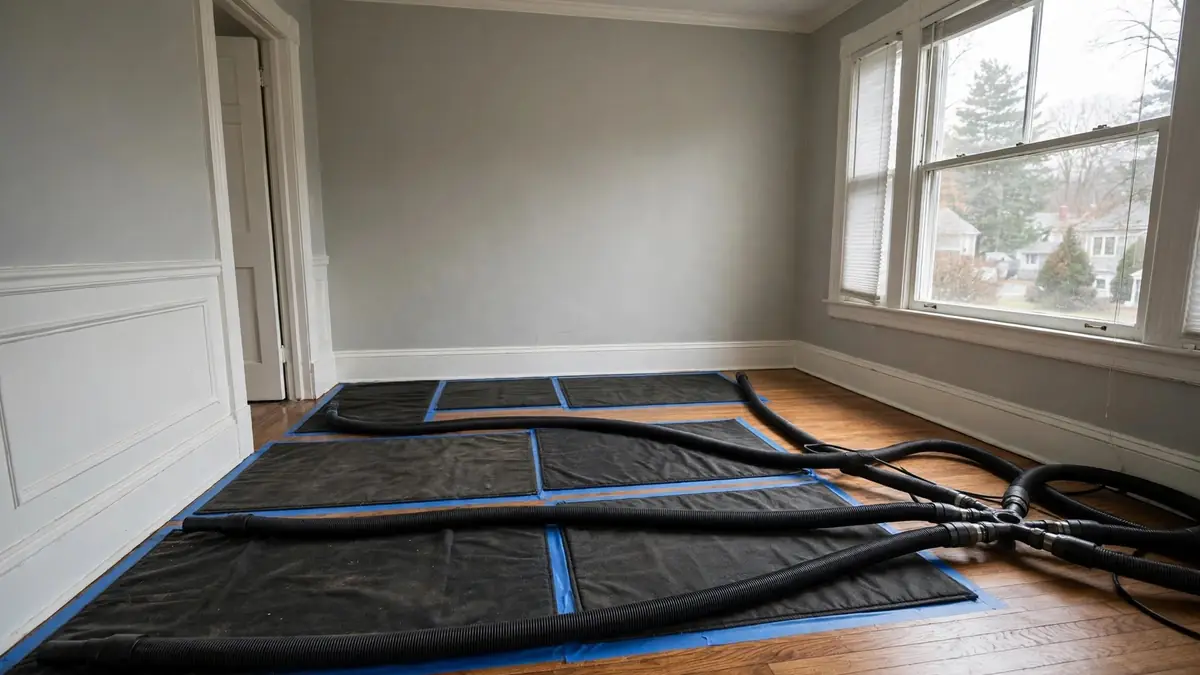
| Floor drying mats | Draw moisture up through hardwood joints by vacuum | Solid hardwood floors |
| HEPA air scrubber | Filters fine particles from the air | Contaminated water jobs, demolition |
Seasons
How a Connecticut drying job changes through the year
Spring brings snowmelt and heavy rain, which is when basement groundwater problems peak. Drying a basement in April often means fighting water that is still seeping through the foundation, so the source has to be managed before drying can finish. Summer brings humidity: the outdoor air can be wetter than the air inside, so windows stay shut and dehumidifiers carry the load.
Autumn is usually the easiest season for drying, with cooler, drier air. Winter is the season of frozen and burst pipes. The good news is that heated indoor air is fairly dry, so dehumidifiers work efficiently above grade. The bad news is that cold exterior walls, unheated crawl spaces and attics slow everything down, and the contractor may add heat to those areas.
Tell the contractor whether the house has been heated normally since the leak. A home left cold for several days while the owners were away will take longer to bring back.
Multi-family
Drying across units in two- and three-family houses
In multi-family buildings, water from one unit often reaches the ceilings and walls of the units below. Drying then has to happen in several apartments at the same time, with access arranged through the owner and each tenant. Equipment may need to run in an occupied unit, which makes the noise and power plan more important.
The contractor should map all affected units at the start and record readings in each. If you are a tenant, tell your landlord right away and let them coordinate. If you own the building, check with your insurer about how damage in tenants' units is handled under your policy.
Prevention
Keeping moisture down after the job
To discourage mold, the EPA suggests holding indoor humidity under 60 percent, aiming for 30 to 50 percent [2]. In Connecticut basements, that often means a permanent dehumidifier draining to a pump or floor drain during the humid months.
Outside, gutters, downspouts and grading that direct water away from the foundation make a big difference. Inside, a water leak detector near the water heater, washing machine and sump pump can sound an alarm before a small leak becomes a drying job.
Repair or replace
When drying is not the right answer
Drying is not always the right call. Materials soaked by sewage or floodwater, which are contaminated, are usually removed rather than dried [9]. Drywall that has collapsed, swollen particleboard and insulation that is matted down are normally replaced. Materials that already show mold growth are handled under remediation rules rather than simple drying [10].
Everything else, especially framing, subfloor, plaster and solid hardwood, is usually worth drying. Keeping them avoids demolition and shortens the rebuild.
Cabinets are a common judgment call. Base cabinets often sit on the wet floor with a sealed toe kick in front, trapping water underneath. Restorers usually remove the toe kick and blow air beneath, and sometimes drill small holes in the cabinet floor. If the cabinet box is particleboard and has swollen, it rarely recovers and is replaced instead.
Related problems
What usually comes before and after drying
Drying normally follows water extraction. If floors are hardwood, hardwood floor drying is part of the plan. If drying started late, or a musty smell appears, mold prevention after water damage explains what comes next. For a realistic idea of timing, see our guide on how long drying takes.
Insurance
Drying records and the claim
Insurers and adjusters often ask for the drying log: initial readings, daily readings and the final dry readings, along with the equipment used. These records show the work was needed and the house was dried properly. Keep a copy.
If you have questions about your policy or a dispute with your insurer, the Connecticut Insurance Department provides consumer help [11]. Our insurance adjuster guide covers what to prepare.
FAQ
Structural drying questions from Connecticut homeowners
How many days will the drying equipment be here?
Most homes take three to five days after extraction. Dense materials like plaster, hardwood and concrete, cold weather and late starts can stretch it to a week or more.
Is it all right to switch the fans off overnight?
It is best not to. Drying depends on continuous airflow and dehumidification. Turning equipment off lets humidity build back up and adds time.
Why are holes being drilled in my walls?
Small holes near the floor let dry air into the wall cavity so the inside of the wall and the framing can dry without removing the whole wall.
How do you know when it is dry?
Each material is compared with a dry reading from an unaffected area of the same material. When the wet areas match, the job is done.
Do I need a dehumidifier after the job?
In many Connecticut basements, a permanent dehumidifier during humid months helps keep humidity below 60 percent and discourages mold.
Can plaster walls be dried?
Often, yes. Plaster on lath dries slowly but is usually worth keeping. Older plaster may have lead paint, so cutting needs care.
Why does the house feel so warm?
Dehumidifiers release heat as they work, and warm air helps drying. Ask the contractor before changing the thermostat.
Who sets up and checks the drying equipment?
An independent drying and restoration contractor from your part of Connecticut. This site only routes your call to them; the plan, the schedule and any agreement are settled directly with that contractor.
Sources and citations
- [1]IICRC — ANSI/IICRC S500 Standard for Professional Water Damage Restoration
- [2]U.S. EPA — A brief guide to mold, moisture and your home
- [3]Wikipedia — Dehumidifier
- [4]Wikipedia — Relative humidity
- [5]Wikipedia — Efflorescence
- [6]Wikipedia — Lath and plaster
- [7]U.S. EPA — Protect your family from sources of lead
- [8]U.S. EPA — Protect your family from exposures to asbestos
- [9]U.S. EPA — Flooded homes: cleanup and safety
- [10]IICRC — ANSI/IICRC S520 Standard for Professional Mold Remediation
- [11]Connecticut Insurance Department