
Key facts: How long drying takes
The short answer
Three to five days, usually
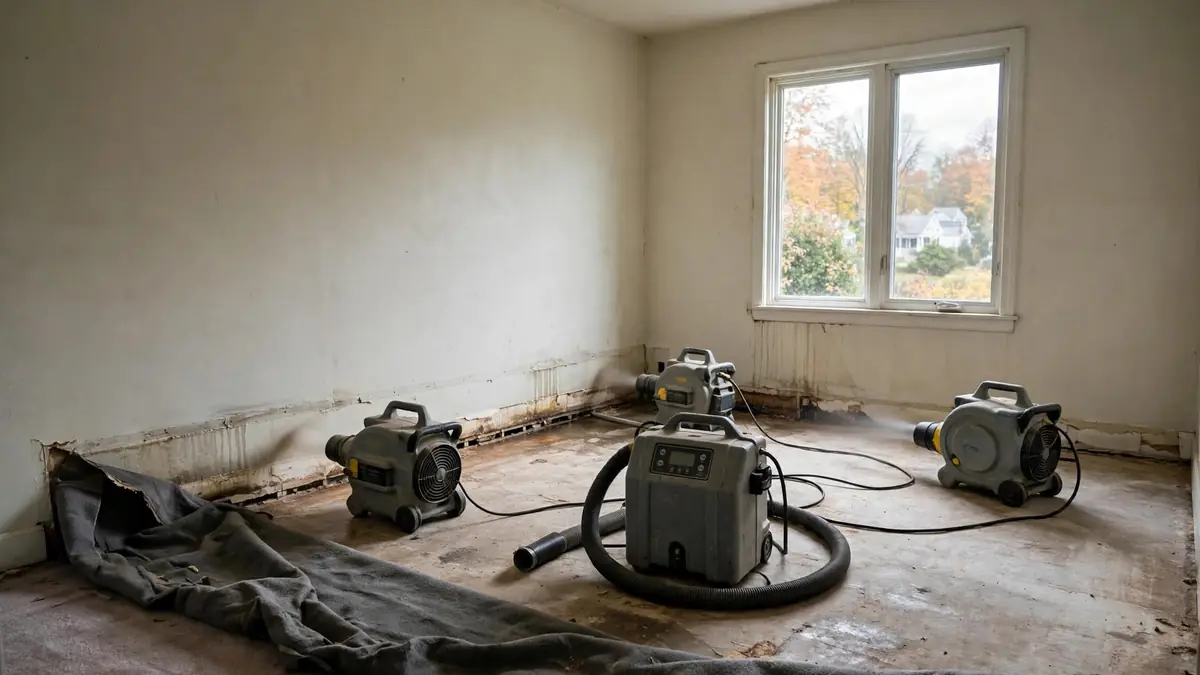
With extraction done and air movers and dehumidifiers running continuously, most rooms with drywall, wood framing and carpet reach their dry readings in three to five days. Dense materials, such as plaster, solid hardwood and concrete, often take longer; wood floors are covered on our hardwood floor drying page. Starting late, cold weather and humid summer air also stretch the timeline.
The finish line is not a feeling but a number. Each material is compared with a dry reading from an unaffected area of the same material, and drying is done when they match [2].
By material
Typical drying times by material
With professional equipment running; ranges vary.
| Material | Typical drying time | Notes |
|---|---|---|
| Carpet (pad removed) | 1 to 3 days | Faster when floated or pad replaced |
| Drywall | 2 to 4 days | Cavity venting speeds it up |
| Wood framing | 3 to 5 days | Sill plates often slowest |
| Plaster on lath | 4 to 7 days or more | Dense; vent holes help |
| Solid hardwood floor | 5 to 14 days | Drying mats; settling continues after |
| Concrete slab or block | A week or more | Holds water deep inside |
Speed
What speeds drying up
These make the biggest difference.
Fast extraction
Every gallon pumped out is a gallon that does not need evaporating.
Removing what will not dry
Pad, wet insulation and swollen particleboard trap water.
Enough dehumidification
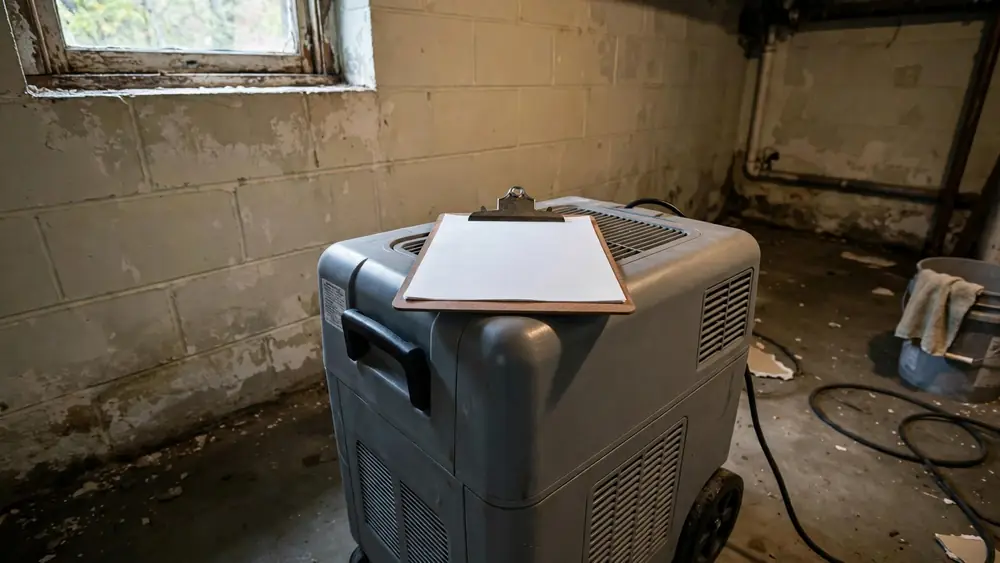
Equipment sized to the water load, not the room alone [3].
Continuous operation
Equipment that runs around the clock dries far faster.
Warmth
Warm air holds more moisture and warm materials release it faster.
Closed drying chambers
Plastic sheeting keeps the dry air where it is needed.
Slowdowns
What slows drying down
The common causes of slow drying are predictable: starting late, turning equipment off at night, leaving windows open on humid days, too few dehumidifiers, and materials that trap water, such as vinyl flooring over a wet subfloor or insulation behind drywall. Cold basements in winter and humid air in summer both slow evaporation.
Water that sat for days also takes longer, because it has soaked deeper into framing, subfloor and concrete. If the house was wet for a long time before anyone found it, expect more removal and a longer drying period.
Seasons
Drying in a Connecticut summer and winter
In summer, humid air off Long Island Sound means the outdoor air is often wetter than the air you want indoors. Windows stay closed and dehumidifiers do the work, as described under structural drying. In winter, heated indoor air is fairly dry, which helps upstairs, but cold basements, crawl spaces and exterior walls dry slowly and may need added heat or desiccant dehumidifiers.
Spring and autumn are often the easiest seasons for drying, with milder temperatures and drier air. The contractor will read the conditions each day and adjust.
Daily checks
What happens during the drying days
A technician usually visits daily. They read moisture at the same points, check temperature and humidity in each drying area and outside, check dehumidifier output and move equipment as areas dry. You should be able to see the readings. If numbers stall for two days, ask what will change.
Equipment is loud and adds heat. Keep doors and windows as the contractor asks, keep equipment plugged in and tell them about any new stains or smells.
Scenarios
Typical timelines for common Connecticut situations
A burst supply line found within an hour in a heated first-floor kitchen, with drywall and vinyl floors, is often dry in about three days once equipment is running. The same leak running overnight into a finished basement with carpet and insulated walls usually means removing pad and the lower drywall, then four to six days of drying for the framing and slab.
A pipe that froze and burst in a house left empty for a week in January is a different job: water has soaked several floors, the house is cold and materials have sat wet for days. Expect more removal and a week or more of drying, often with added heat. A coastal or river flood that soaked a lower level is usually cleaned and gutted first, then dried, and concrete foundations may take well over a week.
Hardwood floors are the long pole in many jobs. Even after the readings say dry, boards may keep flattening for weeks, and decisions about sanding wait until they settle.
Why rushing hurts
Why finishing too early backfires later
It is tempting to close up walls and lay new floors as soon as surfaces feel dry. The trouble is that framing, subfloor and concrete give up water slowly, and new materials laid over them trap it. The result can be cupped new flooring, peeling paint, musty odors and mold behind a freshly painted wall. A few extra days of drying is almost always quicker and less disruptive than redoing the repairs.
Insurers and future buyers also care about the record. A drying log that ends with every material at its dry goal is evidence that the job was finished properly. A log that stops early, or no log at all, invites questions later if a problem appears. Ask for the final report before the equipment leaves, and keep it with your other home records so it is easy to find if anyone asks about the house later.
Your part
How you can help drying go faster
Leave equipment running day and night, even though it is loud. Keep doors and windows as the contractor asks. Keep the thermostat at a normal setting rather than turning the heat down. Empty dehumidifier buckets if yours are not draining to a hose. Tell the technician about anything new: a stain, a smell, a drip or a floor that is changing shape.
Signs
How to tell drying is actually finished
- Readings match dry goalsEach wet material reads like its unaffected counterpart.
- No musty smellOdor usually means something is still damp.
- Floors flat or flatteningHardwood may keep settling for weeks.
- Written final reportAsk for it before repairs begin.
FAQ
Drying time questions
Can I speed up drying with fans from the store?
Box fans help a little with clean water, but professional air movers and dehumidifiers move far more air and remove far more moisture.
Why is my contractor still drying after five days?
Dense materials, late starts and cold or humid weather all extend drying. Ask to see the readings and the trend.
When can I put the flooring back?
Only when the subfloor and walls are confirmed dry, and for hardwood, after the boards have settled.
Do I need to leave the house during drying?
Usually not, but the equipment is loud and runs day and night. Many families stay elsewhere for a few nights.